



Estimated reading time: 8 minutes
Table of contents
Over the years, I have had the pleasure of reviewing numerous audio components from this Japanese company, which has been designing and building well-received products since 1961. More recently, Rotel has continued to design its components in Japan but now manufactures them at their fully owned, 100,000-square-foot global headquarters in Zhuhai, China, where Rotel’s in-house team maintains complete control over product design, build quality, and performance.
In the past, all the Rotel gear that has crossed my threshold and graced one of my audio systems has been standard shelf-sized—that is, until now, when I received a review sample of the very small Rotel DX-5 integrated amplifier. Integrated amplifiers are ideal components for listeners who want to save space but do not want to compromise their audio experience.
The DX-5 is in the House!
As a senior citizen, I really appreciate components that can be easily lifted out of the box, and the 9.1-pound Rotel DX-5 clearly fills that bill. The DX-5 is available in either a silver or a black chassis (my review sample was the latter). With dimensions of 8.5”(D) x 3”(H) x 10”(W), it looked quite tiny in my 18’ x 14’ listening room, particularly when set up with a pair of MartinLogan Expression ESL 13A floor-standing hybrid electrostatic speakers measuring 61” (H) x 13” (W) x 27” (D). The Expressions have a sensitivity of 91dB/2.83 volts/meter, which means they might be a good match for this tiny integrated amp that can generate a maximum of 33 watts of power at this speaker’s nominal 4 Ω impedance.
Setting up the DX-5
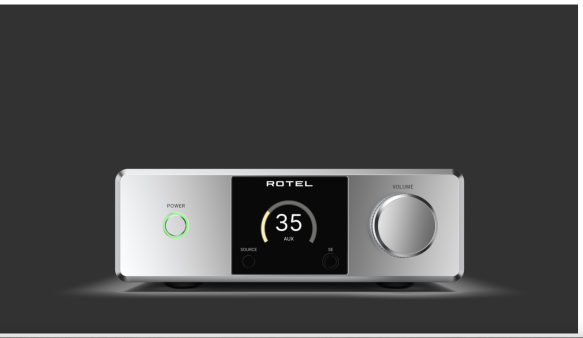
A very utilitarian front panel features, from left to right, a power button, a small display screen, a source button, remote sensor, connector for stereo headphones, and a manual volume control.
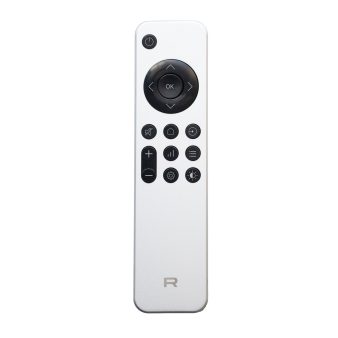
On the rear panel is a PC-USB port supporting up to 32-bit/384kHz PCM and DSD 4x (with DoP), coaxial and optical digital inputs (up to 24-bit / 192kHz), and an aptX™ HD and AAC Bluetooth antenna for high-resolution wireless audio streaming. The internal DAC has an ESS 9039Q2M Sabre chip that converts digital-to-analog at up to 768kHz but the PC-USB DAC port only passes a maximum of 384kHz/24-bit. There is also a single RCA analog input for CD players or other stereo components. Finally, the rear panel has an HDMI ARC input and a subwoofer output for owners wishing to establish the DX-5 as the hub of a 2.1 home entertainment system. (Not having a video system in this room, this latter feature was not evaluated). A small but highly functional remote has a power/standby button, a set of navigation buttons, and buttons for mute, volume, and switching between display screens. A small punch tool is provided for opening the battery compartment and inserting the AAA batteries supplied with the unit.
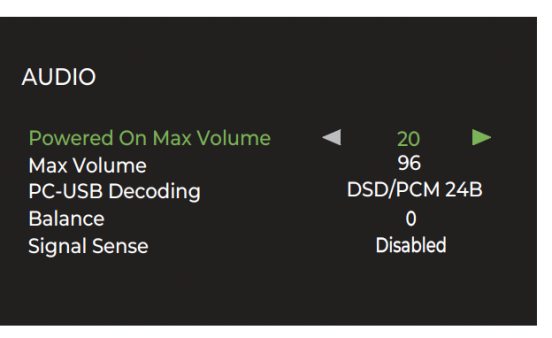
A word about setting up the DX-5 is in order. A thumb drive is supplied for downloading a very thorough 19-page, eight-language Owner’s Manual. There is a series of five interchangeable screens that begin with the main menu, which accesses sources, audio configuration for each source selected, display configuration, and system configuration. With the DX-5 about 10 feet from my listening position, even though I had the small battery-powered remote in my hand, I had to get much closer to see the small display screen and perform the various adjustments needed. Fortunately, once all these setups are completed, they will not need changing unless a new component is added to the system.
Hooking up my sources
With the above information in mind, I proceeded with hooking the DX-5 to my speakers and connecting the other components that would be used in this review: a PS Audio PerfectWave Direct Stream DAC with Bridge II and Direct Stream Memory Player to the analog input, an Esoteric K-01X SACD player to the coaxial input, my MacBook Pro 16 with its large Roon library to the USB input, and my iPhone 16 linked via AAC Bluetooth.
Starting to hear things
I began with one of my go-to tracks, Jacintha’s version of the Leon Russell classic “A Song for You,” accompanied by the Jeremy Monteiro trio, first as a 44.1kHz/16-bit download through the PS Audio DAC/Bridge II and next in SACD format through the PS Audio DAC/Memory Player. As good as the download sounded—and it sounded very good—the DX-5 easily coaxed out the additional space and warmth that this DSD recording lent to the singer’s voice and the accompanying instrumentalists. Next, I went to legendary Dutch blues man Hans Theessink with his distinctive vocals and sharp 12-string guitar on “Way Down in the Hole,” the lead track of “Yedermann Remixed: The Soundtrack.” This time, streaming and CD versions were both 44.1k/16b sources. The DX-5 dug deeply and made an equally good showing for both recordings, bringing this little integrated amp right into my listening room.
I shifted gears again and got the Esoteric SACD player into the act with a classic jazz recording by Duke Ellington on piano and Ray Brown on bass from a 1977 CD that opens with “Do Nothing Till You Hear From Me.” The DX-5 had no trouble getting to the bottom of things with well-articulated bass chords on both instruments. The next challenge for this little guy was provided by one of the finest-sounding classical recordings ever made: a recently upmixed FLAC 176.4kHz/24-bit release of conductor-arranger John Lanchbery’s 1962 recording of excerpts from Ferdinand Herold’s ballet “La Fille Mal Gardee.” Again, to the DX-5’s credit, the placement of the instruments and the wide and deep spread of the Royal Opera House Covent Garden Orchestra were absolutely nailed.
Switching over to the USB connection, I played a number of selections from the Roon library on my MacBook Pro 16, including the same selections by Jacintha/Monteiro, Theessink, and the final one with Lanchbery and his Covent Garden forces. As these downloads traveled directly from their repository to the PS Audio DAC, the audio seemed even better than what I heard through the PS Audio Bridge II via its network connection. More soundstage openness, musical dynamics, and details were present, although, if you are considering taking this route from your favorite listening position, be sure to have a lengthy USB cable (mine was 15’ long).
Finally, I put the Bluetooth connection through its paces again with all the above downloaded sources. Telling it straight, while the sound through the DX-5 was never less than adequate, it was several notches below what I had previously heard through the other digital equipment used in this review. Definitely not the go-to connection for this integrated amplifier.
The Final Assessment
The Rotel DX-5 integrated amplifier is a little gem with smooth operation and an outstanding internal DAC capable of producing excellent sound from high-resolution sources. Being limited to only one analog connection will not faze listeners with digital music libraries. The small display is a minor disadvantage since I could not readily read it from my listening location 10 feet away. But once you have made all the initial connections and adjustments at close range, you can then resume your preferred listening position and let the little remote control unit do the walking.
My reference integrated amplifier, the Pass Labs INT-60, puts out enough power to adequately drive all of my home speakers (including the larger Martin Logan CLXs). However, the Pass integrated does not have a DAC and thus lacks the versatility of the Rotel DX-5. I would never give up the Pass’s glorious Class AB sound, but its list price ($10,350) might make it a bit pricey for some buyers. With respect to value received, the DX-5 integrated stereo amplifier is a wise choice for cost-conscious listeners who want a lot of digital audio options, great build quality, excellent sound, and ease of operation. A highly recommended component that could serve either as a starter unit or as a replacement for one that lacks all these digital playback features that many audio buffs now consider to be essential. The Rotel DX-5 is available for purchase at numerous online audio vendors like Best Buy, Audio Advice, Music Direct, and Crutchfield.
SPECIFICATIONS
Analog Section
Power Output: 25 watts/channel (1kHz, 8 Ohms)
Maximum Power Output: 33 watts/channel (1kHz, 4 Ohms)
Total Harmonic Distortion: <0.03%
Frequency Response: 10Hz-100kHz, 0 + 0.19 dB
Signal to Noise Ratio: >100dB
Digital Section
Frequency Response: 10Hz-80kHz (0+2 dB, Max)
Signal to Noise Ratio: >100 dB
Digital Inputs:
SPDIF LPCM (up to 192kHz/24bit)
PC-USB: USB Audio Class 2.0 (up to 384kHz/32bit). Supports DSD (up to 4X, 11.2M Hz) and DoP (Up to 2X, 5.6 MHz)
HDMI: Supports ARC function
General
Power Requirements:
USA: 120V, 60Hz
EC: 230V, 50Hz
Standby Power Consumption (Normal): <0.5 Watts
Dimensions (W x H x D): 215 x 76 x 251 mm (8.5” x 3” x 10”)
Panel Height: 70 mm (2.75”)
Weight: 4.1 kg (9.1 lbs)
More Information:
Brand: Rotel
Website: www.rotel.com
MSRP: $1699